
Total Expense Ratio (TER) in Mutual Funds: Costs Explained
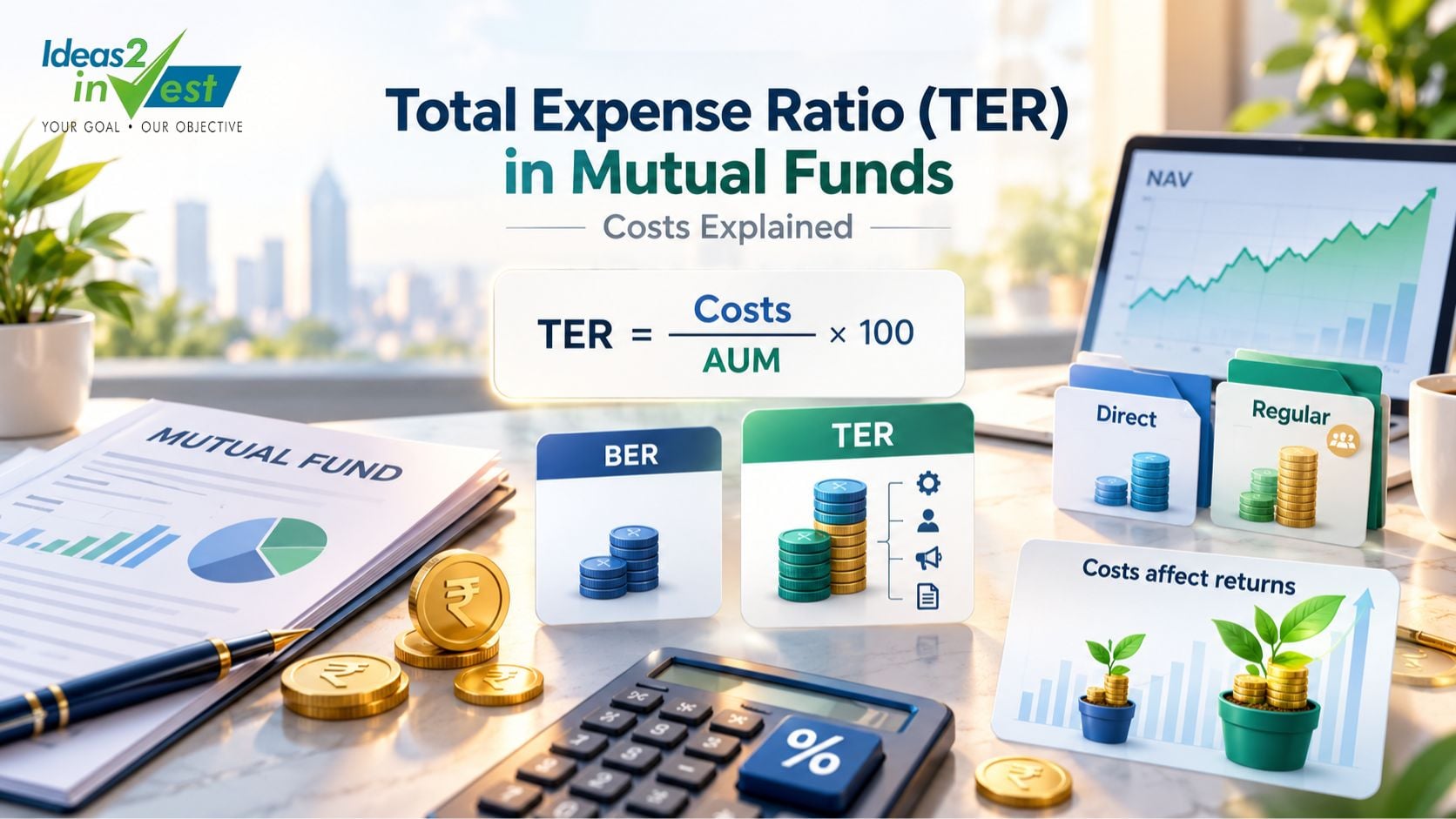
A fund's return attracts attention, but its running costs deserve a look too. The Total Expense Ratio (TER) helps you understand what it costs to operate your mutual fund investment and how those costs affect the value you keep.
What Does TER Mean for Your Investment?
Think of TER as the fund's operating-cost percentage. A hypothetical TER of 1.20% a year represents about ₹120 of annual expenses for every ₹10,000 of assets, assuming the asset value and rate stay constant. Actual charges vary as assets and expenses change.
BER vs TER: Understanding the 2026 Framework
The SEBI mutual fund framework effective from 1 April 2026 separates the Base Expense Ratio (BER) from the broader TER. BER covers specified management, operating and distribution expenses; TER also includes permitted brokerage, trade-execution transaction costs and statutory levies.
A lower displayed BER does not, by itself, reveal the entire cost. Check what the label includes before comparing two schemes. AMFI's current disclosure format lists the expense components separately.
Which Costs Make Up TER?
| Component | What it covers |
|---|---|
| Base expenses | Fund management, administration, audit, custody, registrar services and permitted distribution expenses |
| Brokerage | Permitted broker charges for executing the fund's trades |
| Trade-execution costs | Eligible exchange, clearing and other regulatory transaction charges |
| Statutory levies | Applicable taxes and levies, including GST and relevant trading-related charges |
TER Calculation: Formula and Worked Example
Use total annualised scheme costs and average assets under management (AUM) for the same period. The result is a percentage. This is a simplified illustration; actual disclosures follow the prescribed accounting methodology.
Suppose a scheme has average assets of ₹500 crore. Its illustrative annualised expenses are:
| Expense | Illustrative amount |
|---|---|
| Base expenses | ₹4.00 crore |
| Brokerage | ₹0.25 crore |
| Trade-execution costs | ₹0.15 crore |
| Statutory levies | ₹0.60 crore |
| Total | ₹5.00 crore |
The TER is (₹5 crore ÷ ₹500 crore) × 100 = 1.00%. The base expenses alone are 0.80%. This shows why BER and TER should not be treated as interchangeable. These figures are examples, not actual scheme charges.
Direct and Regular Plans: Comparing Costs
Direct and regular plans of the same scheme share the investment portfolio, but their expense structures differ. Direct plans exclude distributor commissions and distribution expenses, so their expense ratio is lower. Regular plans include permitted distribution costs.
A regular plan may suit an investor who wants distributor assistance with product understanding and the investment process. Assess that support alongside the cost difference. Ideas2Invest is an AMFI Registered Mutual Fund Distributor, ARN-113588; it does not manage the scheme's portfolio.
How Fees Affect the Amount You Keep
Consider ₹1,00,000 invested for one year with an assumed 10% return before costs. Using a simplified annual subtraction:
| Illustration | Cost assumption | Net return | Year-end value |
|---|---|---|---|
| Scenario A | 1.00% | 9.00% | ₹1,09,000 |
| Scenario B | 1.50% | 8.50% | ₹1,08,500 |
With the same assumptions held for ten years, the values would be approximately ₹2,36,736 and ₹2,26,098: a gap of ₹10,638. Costs reduce both the amount retained and what remains available to compound. See our compounding guide for the underlying idea.
How to Judge a Fund's Expense Ratio
There is no single ideal percentage for every scheme. Compare funds doing a similar job: an index tracker and an actively managed equity fund use different processes. For an index fund, also examine how closely it follows its benchmark; for an active fund, consider results and risk after expenses.
For a fund of funds, check both the fund's own expenses and the underlying investment costs. Keep exit loads separate from TER when estimating what a withdrawal would cost. For reading annualised returns, our XIRR vs CAGR guide can help.
Where to Find a Scheme's Latest TER
1. Check the AMC: Open the fund house's official scheme page and expense disclosures. Confirm the scheme name and whether you hold the direct or regular plan.
2. Cross-check AMFI: Use AMFI's TER disclosure tool, selecting the relevant period, fund category and AMC.
3. Compare like with like: Check the date, annualised basis and components. A platform's base-expense figure should not be compared directly with another source's all-in TER.
Frequently Asked Questions
Is TER charged separately from my mutual fund investment?
Scheme expenses are generally reflected in NAV rather than collected as a separate annual payment. Other applicable investor charges, such as exit loads, should be checked separately.
Does a 1% expense ratio mean 1% every month?
No. A quoted annual expense ratio is an annualised figure. Expenses accrue within the scheme; it does not mean a fresh 1% charge every month.
What is the difference between BER and TER?
BER covers specified base expenses. TER is the broader measure including permitted brokerage, trade-execution transaction costs and statutory levies as well. Check the disclosure labels before comparing costs.
Why do regular plans have a higher expense ratio?
Regular plans include permitted distributor-related expenses and commissions. Direct plans exclude those costs. Investors should compare both the cost and the assistance they need.
Should I subtract TER from the returns shown on my statement?
Not again if the returns are calculated from NAV after scheme expenses. Subtracting it a second time would understate those returns.
Should I choose a mutual fund only because its TER is low?
No. Check the investment objective, category, risk and results after expenses. A low fee does not make an unsuitable fund suitable for your goal.
Conclusion
Treat TER as one part of your fund review. Understand the full cost, compare equivalent plans and categories, and assess what remains after expenses. Your goal and risk profile should still guide the investment decision.
Want to understand the costs in your mutual fund portfolio? Speak with Ideas2Invest about scheme expenses and the investment process.