
Daily SIP vs Weekly SIP vs Monthly SIP: Which Is Better?
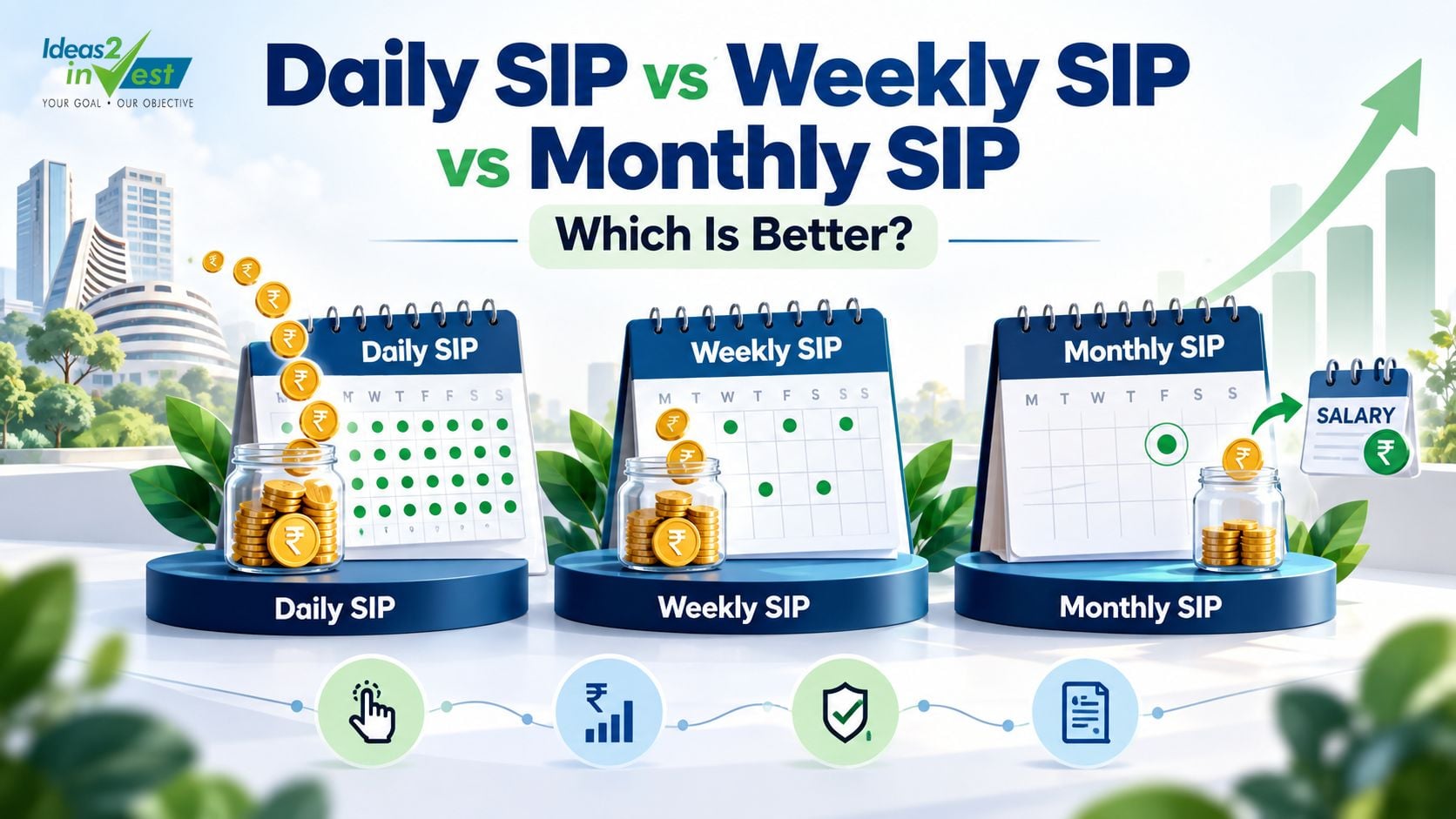
A Systematic Investment Plan, or SIP, is one of the simplest ways to build wealth through mutual funds. But once investors decide to start, one common question appears almost immediately: should the SIP run daily, weekly, or monthly?
Still, the right frequency can make your investing habit easier to maintain. A good SIP is not the one that looks clever on paper. It is the one you can continue comfortably through salary cycles, market corrections, family expenses, and changing goals.
Key Takeaways
Monthly SIP: Best suited for most salaried investors because it is simple, predictable, and easier to reconcile with monthly income and expenses.
Weekly SIP: A useful middle path if you prefer spreading investments across the month without creating daily transaction clutter.
Daily SIP: Gives the highest number of purchase points, but also creates 250+ annual transactions and may not materially improve long-term returns.
Best decision factor: Choose the SIP frequency that you can maintain consistently. Fund selection, tenure, asset allocation, and regular review matter more than frequency alone.
What Does SIP Frequency Actually Mean?
SIP frequency means how often money is deducted from your bank account and invested into a mutual fund scheme. A monthly SIP invests once a month, a weekly SIP invests once a week, and a daily SIP invests on trading days.
All three formats use the same basic idea: invest a fixed amount regularly instead of waiting for the perfect market level. This supports Rupee Cost AveragingA method where regular investments buy more units when prices are lower and fewer units when prices are higher, helping average the purchase cost over time.. You can learn the basics in our mutual funds guide before choosing a frequency.
Monthly SIP: Simple, Clean, and Easy to Track
A monthly SIP invests a fixed amount on a selected date every month. For most salaried investors, this is the most practical format because income, rent, EMIs, and household budgets are usually monthly.
If your salary is credited on the 1st or 5th, you can schedule your SIP soon after that date. This reduces the chance of a failed SIP due to low bank balance and makes record-keeping simple. For long-term goals, you can estimate the required amount with our goal SIP calculator.
Weekly SIP: A Middle Path Between Discipline and Frequency
A weekly SIP invests a fixed amount every week. It gives you more entry points in the market than a monthly SIP, without creating the transaction load of daily investing.
This can suit investors who receive income weekly, run a business with frequent cash inflows, or simply prefer dividing the monthly SIP amount into smaller weekly parts.
Daily SIP: Maximum Frequency, Maximum Transactions
A daily SIP divides the planned investment amount into smaller daily contributions, usually on market trading days. For example, a person targeting about Rs. 6,000 per month may invest roughly Rs. 250 per trading day.
Daily SIPs create many more investment entries. This may look attractive because money enters the market across many price points, but it also means more transactions, more statements, and more tracking.
Daily SIP vs Weekly SIP vs Monthly SIP
| Factor | Daily SIP | Weekly SIP | Monthly SIP |
|---|---|---|---|
| Investment rhythm | Every trading day | Once every week | Once every month |
| Approx. transactions per year | 250+ | 52 | 12 |
| Record-keeping | Highest effort | Moderate effort | Lowest effort |
| Cash-flow requirement | Frequent bank balance needed | Weekly balance needed | Monthly balance needed |
| Cost averaging | Most price points | More than monthly | Adequate for long-term investors |
| Best fit | Investors comfortable with many entries | Investors wanting a middle path | Most salaried and beginner investors |
The transaction difference is important. A monthly SIP usually creates 12 investment entries in a year, a weekly SIP creates around 52, and a daily SIP may create more than 250 because it generally follows market trading days.
Which SIP Frequency Is Best for Different Investors?
| Investor type | Better SIP frequency | Why it may fit |
|---|---|---|
| Salaried investor | Monthly SIP | Matches monthly income, budget planning, and bank balance cycles |
| Business owner or freelancer | Weekly SIP | Can align better with frequent or irregular cash inflows |
| Beginner investor | Monthly SIP | Simpler to understand, track, and continue |
| Investor wanting smaller deductions | Weekly SIP or daily SIP | Divides the total monthly commitment into smaller parts |
| Investor with many financial goals | Monthly SIP | Easier to map each SIP to goals such as retirement, education, or wealth creation |
Does a Daily SIP Give Better Returns Than Monthly SIP?
This is where many investors overthink. A daily SIP may capture more price points, but over long periods the return gap between daily, weekly, and monthly SIPs is usually not large enough to become the main decision factor.
The bigger drivers are the quality of the mutual fund, the time you stay invested, whether you continue during market declines, and whether the fund matches your goal and risk profile. If you want to improve your SIP outcome, read our guide on smart ways to maximize SIP returns and our note on why stopping SIPs during panic can hurt long-term wealth.
SIP success is less about choosing the perfect frequency and more about choosing a frequency you will not interrupt.
- Ideas2Invest Team
How to Choose the Right SIP Frequency
1. Match it with income: If income is monthly, monthly SIP is usually cleaner. If income is weekly or irregular, weekly SIP may feel more natural.
2. Keep tracking simple: More transactions mean more entries in statements, tax records, and portfolio reviews. If simplicity matters, monthly SIP wins.
3. Avoid failed mandates: A SIP that fails repeatedly because the bank account has insufficient balance hurts discipline. Pick a date or rhythm that keeps enough balance available.
4. Focus on goals: A SIP for retirement, child education, or long-term wealth creation needs the right asset allocation more than the fanciest frequency. You can also use our SIP calculator to estimate future value or our reverse calculator to estimate how much SIP may be needed for a target corpus.
5. Review asset allocation: SIP frequency cannot fix poor portfolio construction. A suitable mix of equity, debt, hybrid, and other categories should reflect your goals and risk comfort. Our asset allocation guide explains why this matters.
Ideas2Invest Recommendation
For most investors, a monthly SIP remains the most practical choice. It is easy to budget, easy to track, and aligns well with salary cycles. Weekly SIP can work well if you want a slightly more spread-out entry pattern without daily transaction clutter.
Daily SIP can be useful for investors who like smaller frequent deductions and are comfortable with a high number of transactions. But it should not be chosen only because it sounds more precise.
Not sure which SIP rhythm fits your goals? Speak with Ideas2Invest and build a disciplined mutual fund plan around your cash flow, time horizon, and risk profile.
Frequently Asked Questions
Which SIP frequency is best: daily, weekly, or monthly?
For most investors, monthly SIP is the best balance of discipline, convenience, and easy tracking. Weekly SIP can suit investors who prefer smaller weekly investments. Daily SIP creates the most transactions and does not automatically guarantee better returns.
Is monthly SIP better than daily SIP?
Monthly SIP is usually better for investors who want simplicity, easy tracking, and alignment with salary cycles. Daily SIP gives more purchase points, but it also creates many more transactions and does not automatically improve long-term returns.
Does daily SIP give higher returns than monthly SIP?
Not necessarily. Daily SIP captures more price points, but over a long investment period the return difference is usually marginal. Fund selection, investment tenure, and consistency matter more.
Is weekly SIP better than monthly SIP?
Weekly SIP offers more frequent investing than monthly SIP, but it also creates more transactions. It can be useful if your cash flow is weekly or if you prefer spreading the monthly amount into smaller parts.
What is the best SIP date for monthly investors?
There is no universally best SIP date. A practical approach is to schedule the SIP soon after your salary or regular income is credited, so the payment is less likely to fail.
Which SIP frequency is best for salaried investors?
Monthly SIP is usually the most practical option for salaried investors because income, expenses, EMIs, and household budgets are generally monthly.
Can I start a daily SIP in mutual funds?
Some platforms and schemes may allow daily SIPs, but availability can vary. Before choosing daily SIP, consider the transaction load, bank balance requirement, and whether it genuinely improves your investing discipline.
Should I split one monthly SIP into weekly SIPs?
You can split a monthly SIP into weekly SIPs if it helps your cash flow or discipline. However, do not expect the split alone to create a major long-term return advantage. The fund, time horizon, and consistency are more important.
Does SIP date matter for long-term investing?
For long-term investors, SIP date usually matters less than consistency. Pick a date when your bank balance is stable, preferably soon after income is credited.
Should beginners choose daily SIP?
Beginners usually benefit more from keeping things simple. A monthly SIP is easier to understand, track, and continue. Daily SIP can be considered later if the investor is comfortable with frequent transactions.
The Bottom Line
Conclusion
Daily, weekly, and monthly SIPs are all tools for disciplined investing. The best frequency is the one that fits your income pattern and keeps you consistent for years. Do not let the search for a perfect SIP date delay the more important decision: starting, staying invested, and reviewing your portfolio regularly.